Complete Letter of Credit (LC) Process: From Opening to Final Payment
Complete Letter of Credit (LC) Process: From Opening to Final PaymentIntroductionA Letter of Credit (LC) is one of the safest payment methods used in international trade. It protects both the exporter and importer by involving banks in the payment process. The buyer gets assurance that goods will be shipped correctly, while the seller gets assurance of payment if all terms are fulfilled.
This blog explains the complete LC process step-by-step in simple language, from the initial purchase order until final payment settlement.
What is a Letter of Credit?
A Letter of Credit (LC) is a written guarantee issued by a bank on behalf of the buyer (importer), promising payment to the seller (exporter) if all terms and documents mentioned in the LC are correctly submitted.
Main Parties Involved in LC
Party Role
Importer / Buyer Purchases goods
Exporter / Seller. Supplies goods
Issuing Bank. Opens LC on behalf of buyer
Advising Bank. Informs exporter about LC
Confirming Bank. Adds payment guarantee (if applicable)
Negotiating Bank. Checks documents and processes payment
Shipping Company. Transports goods
Insurance Company. Provides insurance cover
Types of Letter of Credit
1. Sight LC
Payment is made immediately after documents are accepted.
2. Usance LC
Payment is made after a specified credit period such as 30, 60, or 90 days.
3. Confirmed LC
Another bank guarantees payment in addition to the issuing bank.
4. Transferable LC
The beneficiary can transfer LC benefits to another party.
5. Revolving LC
Used for repeated transactions.
Complete LC Process Step-by-StepStep
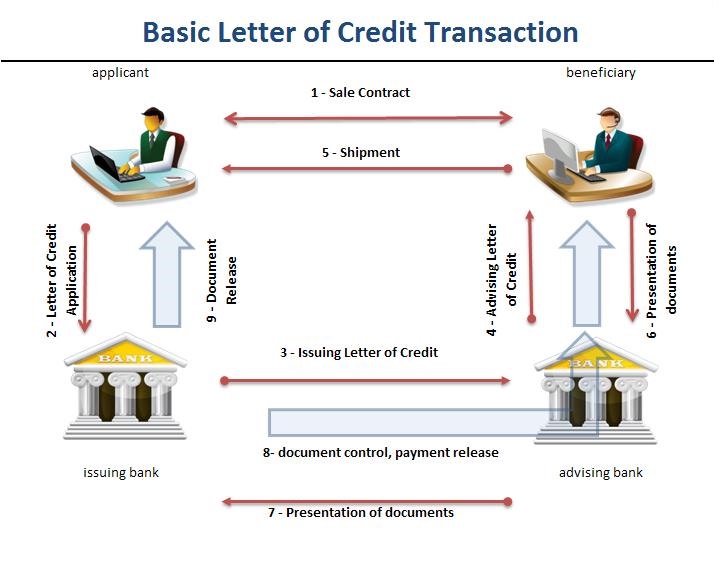
1: Sales Agreement Between Buyer and Seller
The importer and exporter finalize:
Product details
QuantityPrice
Delivery terms
Payment terms
LC conditions
A Purchase Order (PO) or sales contract is signed.
Example
An Indian importer agrees to buy machinery from Germany worth USD 50,000 through LC payment.
Step 2: Importer Requests LC Opening
The importer approaches their bank and submits:
LC application form
Import license (if required)
Purchase contract
IEC code
Financial documents
Margin money
The bank checks:
Creditworthiness
Business profile
Transaction risk
Step 3: Issuing Bank Opens LC
After approval, the issuing bank creates the LC mentioning:
Amount
Expiry date
Shipment date
Required documents
Payment terms
Port details
Incoterms
The LC is sent through SWIFT message to the exporter’s bank.
Step 4: Advising Bank Notifies Exporter
The advising bank check:
Verifies authenticity of LC
Advises LC to exporter
Exporter carefully checks:
Product description
Amount
Shipment deadline
Documentation requirements
If any mistake is found, amendment is requested.
Step 5: Exporter Ships Goods
After LC acceptance:
Goods are manufactured or arranged
Shipment is booked
Cargo is dispatched
Shipping company issues transport document such as:
Bill of Lading (B/L)
Airway Bill (AWB)
Step 6: Exporter Prepares Documents
Exporter prepares all required documents mentioned in LC.
Common Documents
Document. Purpose
Commercial Invoice. Goods value details
Packing List. Packaging information
Bill of Lading. Proof of shipment
Certificate of Origin. Country of origin
Insurance Certificate. Insurance proof
Inspection Certificate. Quality verification
Step 7: Documents Submitted to Bank
Exporter submits documents to negotiating/advising bank within the allowed period.The bank checks whether documents comply with LC terms under:
UCP 600 rules
Banking guidelines
Step 8: Document Examination
Banks examine:
Date consistency
Signature correctness
Amount matching
Shipment details
Document completeness
If Documents are Correct -Documents are accepted.
If Discrepancies Found-Bank informs exporter for correction or importer approval.
Common Discrepancies.
Late shipment
Spelling errors
Invoice mismatch
Missing documents
Step 9: Documents Sent to Issuing Bank.
Negotiating bank forwards documents to issuing bank.
Issuing bank rechecks all documents.
Step 10: Payment to Exporter
In Sight LC
Payment is released immediately after document acceptance.
In Usance LC
Payment is made after credit period ends.
Payment is credited to exporter’s account.
Step 11: Importer Receives Documents
Importer receives shipping documents from issuing bank after:
Payment made or
Acceptance under usance LC
Importer uses documents to clear goods from customs.
Step 12: Goods Delivery and Final Settlement
Goods are delivered to importer.
Transaction is completed after:
Bank settlement
Loan adjustment (if any)
Charges recovery
Closure of LC liability
Flow Chart of LC Process
Charges in Letter of Credit
Charge Type. Paid By
LC Opening Charges. Importer
Swift Charges. Usually Importer
Advising Charges. Exporter/Importer
Confirmation Charges. Usually Exporter
Discrepancy Charges. Responsible Party
Advantages of LC
For Exporter:
Payment security
Reduced buyer risk
International trade confidence
For Importer:
Payment only against valid documents
Better trust with suppliers
Controlled transaction process
Risks in LC
Risk. Explanation
Document Discrepancy. Delay in payment
Fraud Risk. Fake documents possible
Country Risk. Political/economic issues
Exchange Rate Risk. Currency fluctuation
Important International Rules
Most LCs follow:
UCP 600 – Uniform Customs and Practice for Documentary Credits.
Issued by International Chamber of Commerce (ICC)
Conclusion,
A Letter of Credit is one of the most reliable payment systems in global trade. It creates trust between buyers and sellers located in different countries. Although the process involves multiple stages and documents, proper understanding of LC operations helps businesses avoid risks and ensure smooth international transactions.
Businesses involved in export-import should understand every stage of LC processing to reduce discrepancies, avoid delays, and improve trade efficiency.
The above mentioned information is only for educational purposes.
0 Comments